360 Digital Care Consent Manager
Cookie consents without the stress. Compliant with Google.
It’s standard for EU business. Since March 2024, Google Consent Mode v2 has been the mandatory standard for anyone operating within the EU. It shifts the power to the visitor, and your website must handle their choices perfectly.
If you rely on:
- Google Analytics 4
- Google Ads
- Remarketing & Marketing Tools
…then outdated consent settings are already costing you. Without a proper setup, you are losing critical data, damaging your campaign performance and failing to meet EU legal requirements.
We handle the complexity for you. We make sure your tracking works while you stay compliant.
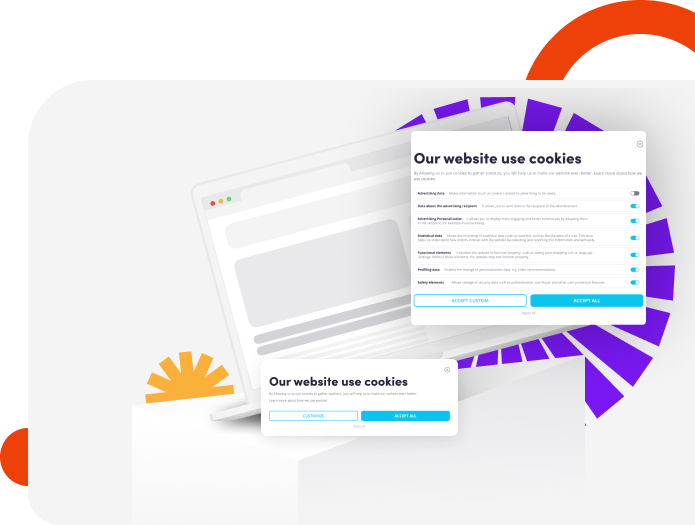

360 Digital Care Consent Manager
Simple consent. Clear conscience
We built our own dedicated WordPress plugin to cut through the complexity. No workarounds, no bloat, just a rock-solid solution that:
- Fully supports Google Consent Mode v2 (Advanced Mode).
- Manages all 7 essential consent types (4 core + 3 additional).
- Runs flawlessly without slowing down your site.
Your visitors get a crystal-clear interface, Google gets the signals it demands, and you get peace of mind and data that actually works.
No subscriptions. No catches
Pay once for the setup, and the plugin is yours – unlimited use, no recurring fees. This isn’t a SaaS. You won’t find any monthly bills, hidden subscriptions or locked features here. You pay a one-time fee for implementation, and that’s it. No expiration dates and no changing the rules down the line. You own your compliance.
-

Total cost control with zero hidden surprises
-
Full access to every feature – no limits, no paywalls
-
No monthly plans, no contracts, no strings attached
-
Clear, transparent terms that won’t change over time

Consent that actually works
Why is a standard cookie banner no longer enough?
Because Google Consent Mode v2 demands more than just showing a message. It requires your website to accurately translate those user choices into signals that Google’s tools can understand.
A standard banner simply doesn’t do this. The result? Your Analytics data is incomplete, your Google Ads underperform, and your site fails to meet mandatory requirements in the EU market.
360 Digital Care Consent Manager implements consent exactly the way Google expects. No workarounds. No half-measures.
How does it work in practice?
The entire process is fully automated. We ensure your visitors aren’t bothered more than necessary, while you get perfectly implemented consent signals.
You get total compliance; your visitors get a clear, simple choice.
Simple. Clear. Effective.
-
User chooses consent
-
Plugin handles the rest
-
Google receives the signals
-
Data and ads work perfectly
One-time implementation fee
-
Standard WordPress Website
250 -350 AUD (net)
-
WooCommerce Online Store
350 – 550 AUD (net)
Cookie consent. Done right, once and for all.
Who is this for?
- Website & Store Owners: Specifically those running on WordPress and WooCommerce.
- Compliance-Focused Businesses: Companies that need their tracking to stay 100% Google-compliant.
- The “Set & Forget” Crowd: For those who want to resolve the problem now and never think about it again.
Order the 360 Digital Care Consent Manager implementation today. Ensure your website meets Google’s requirements with total confidence – no subscriptions, no workarounds and zero stress.
Because with us, everything works. Technically, too.
How Consent Mode v2 works: Implementation Details
Our solution is a dedicated WordPress plugin that gives you full command over your compliance. It manages 4 core and 3 additional consent types, providing everything necessary for a full Google Consent Mode v2 (Advanced Version) implementation.
Unlike most tools on the market, our plugin requires no subscriptions or recurring fees. You pay once for the implementation (see pricing below), and that’s it. This is not a SaaS; it’s a permanent solution for your website. No monthly bills, no surprises, just a rock-solid setup.
Core Consent Types
- Statistical Data [analytics_storage] – Enables the storage of analytical data (such as cookies), including session duration. This data helps you understand how visitors interact with your site by collecting and reporting information anonymously.
- Advertising Data [ad_storage] – Allows the storage of information (such as cookies) related to advertising.
- Ad User Data [ad_user_data] – Enables the transmission of user-related advertising data to Google’s services.
- Ad Personalization [ad_personalization] – Allows for the display of more engaging and relevant ads by tailoring them to the recipient, essential for effective remarketing.
Additional Consent Types
- Functional Elements [functionality_storage] – Ensures the website operates correctly by saving essential settings like shopping cart contents or language preferences. Without these, the site may not function as intended.
- Profiling Data [personalization_storage] – Enables storage of personalisation-related data, such as tailored video recommendations or custom site layouts.
- Security Elements [security_storage] – Allows the storage of security-related data, including authentication processes, fraud prevention and other features designed to protect the user.
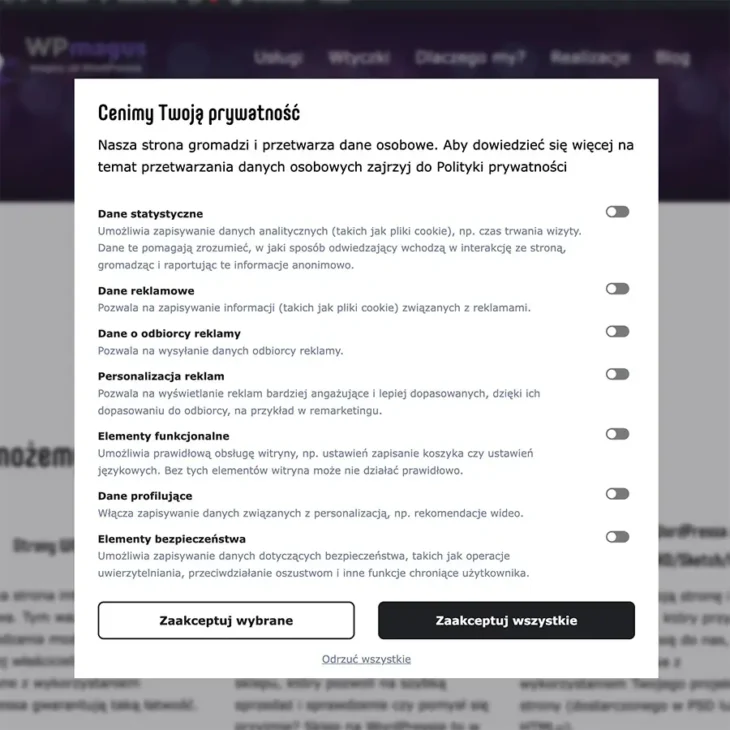
The User Interface: Simple Pop-up
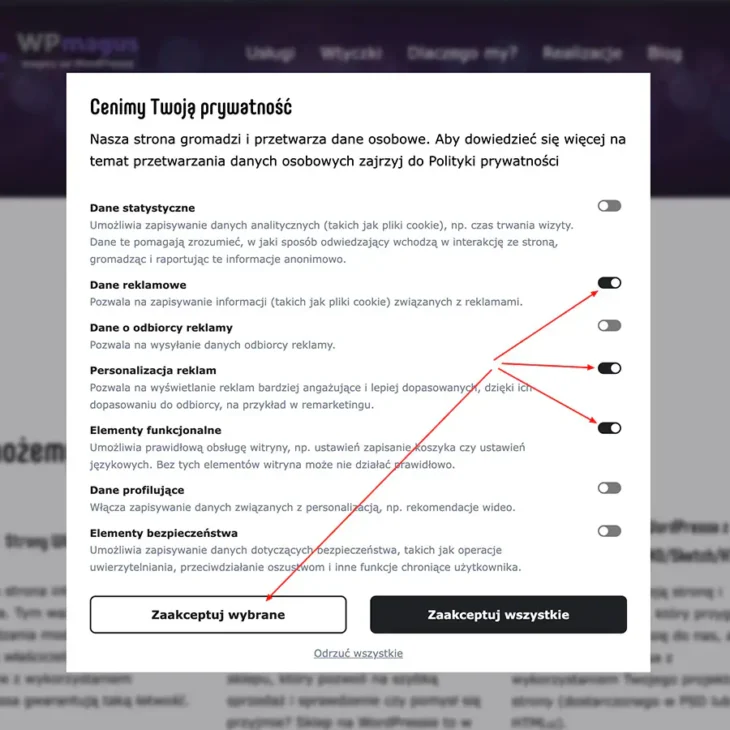
The visitor can grant consent in three straightforward ways via the pop-up window:
- Accept All
- Accept Selected
- Reject All
Once a choice is made, the plugin stores the preferences in a 1st-party cookie. This cookie remains in the browser until cleared. On subsequent visits, the plugin automatically reads this cookie and pushes the data to the Data Layer.
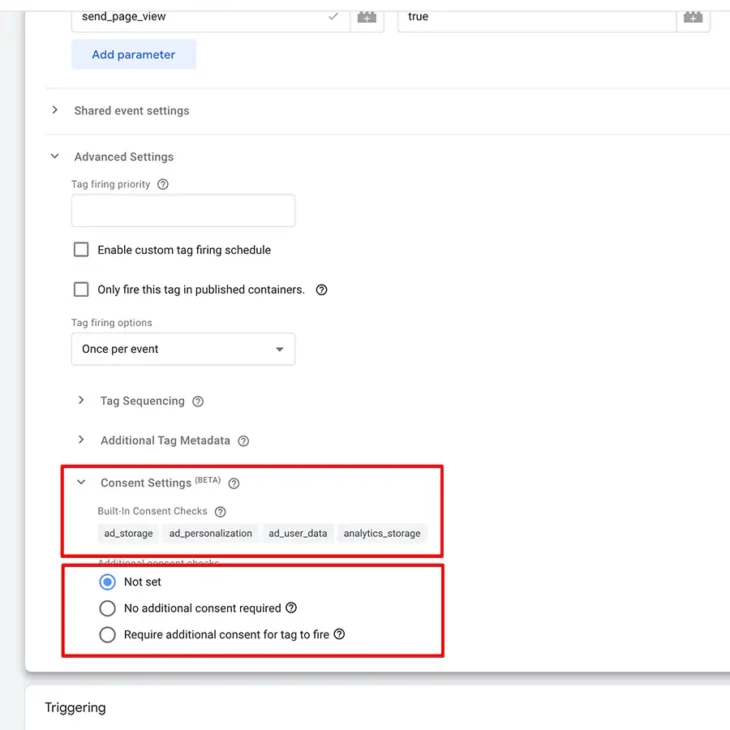
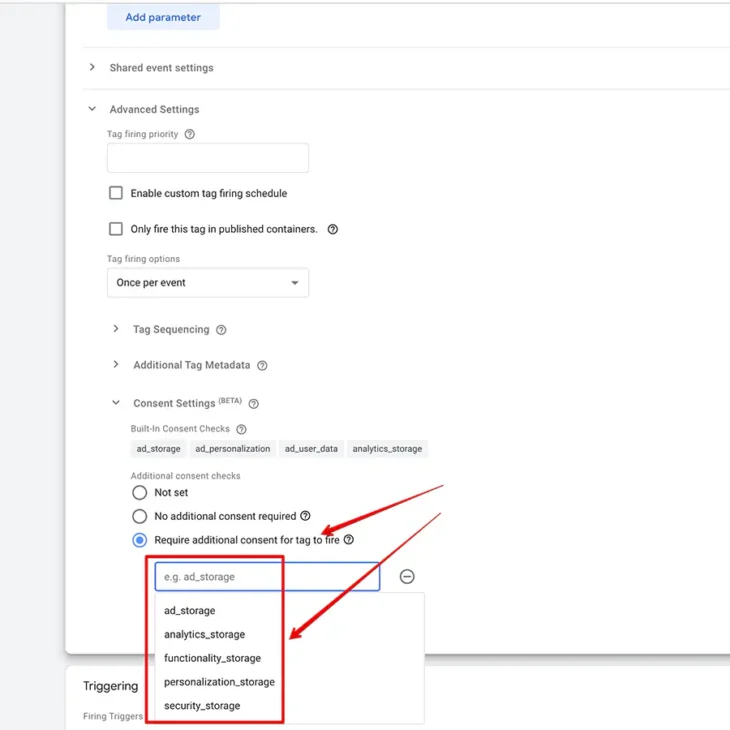
The plugin integrates with Google Tag Manager via the Data Layer, transmitting both default and updated consent states. It eliminates the need for manual tags, variables, or triggers in GTM, as all settings are managed directly within the Advanced Settings -> Consent Settings of your existing tags.
Utilising Google’s native Consent Initialisation trigger, the plugin automatically sets the initial state. When consent is granted or retrieved from a 1st-party cookie, the plugin sends an immediate update to the Data Layer, allowing GTM to process the signals in real-time.ysyła stan „update” i przekazuje zgody do tablicy Data Layer a GTM je odczytuje.
Additional Information
Our solution works in perfect synergy with Google Tag Manager, allowing you to seamlessly manage all other tracking codes – including social media pixels, heatmaps (e.g., Hotjar, Microsoft Clarity) and other user-tracking scripts.
To unlock full functionality, all tracking codes should be deployed via Google Tag Manager. Our plugin supports all standard GTM tags and templates, including:
- Social Media: Meta Pixel, LinkedIn Insight Tag 2.0, Pinterest Tag, TikTok Pixel.
- Heatmaps: Hotjar, Crazy Egg, Microsoft Clarity.
- Custom HTML Tags: Any custom HTML or JS code.
- Thousands of other templates.
Achieving full compliance for these tags simply requires configuring the consent settings as shown in the “Google Tag Manager – Additional Consent Settings” image above.
Implementation Costs
Standard WordPress Website
250 -350 AUD (net)
WooCommerce Online Store
350 – 550 AUD (net)
Prices are net (excluding VAT). One-time payment, no hidden fees.
360 Digital Care Consent Manager
Expert implementation for your WordPress site
Legal Background: Why Google Consent Mode is mandatory in EU
The requirement to obtain user consent stems from European privacy laws, specifically the ePrivacy Directive and the General Data Protection Regulation (GDPR). Google’s policies directly reflect these legal frameworks. Furthermore, marketers using Google’s advertising ecosystem are legally required to obtain and honour user consent.
In 2024, Google expanded its EU User Consent Policy to include all measurement and audience solutions. To maintain campaign effectiveness within the European Economic Area (EEA), advertisers must transmit verifiable consent signals to Google.
These changes marked a mandatory transition to Consent Mode across Google Ads, Google Marketing Platform and Google Analytics. To retain access to critical features like ad personalisation and advanced tracking, businesses were required to implement these systems by March 2024. Today, operating without a verified Consent Mode implementation risks data loss and non-compliance.
FAQ